
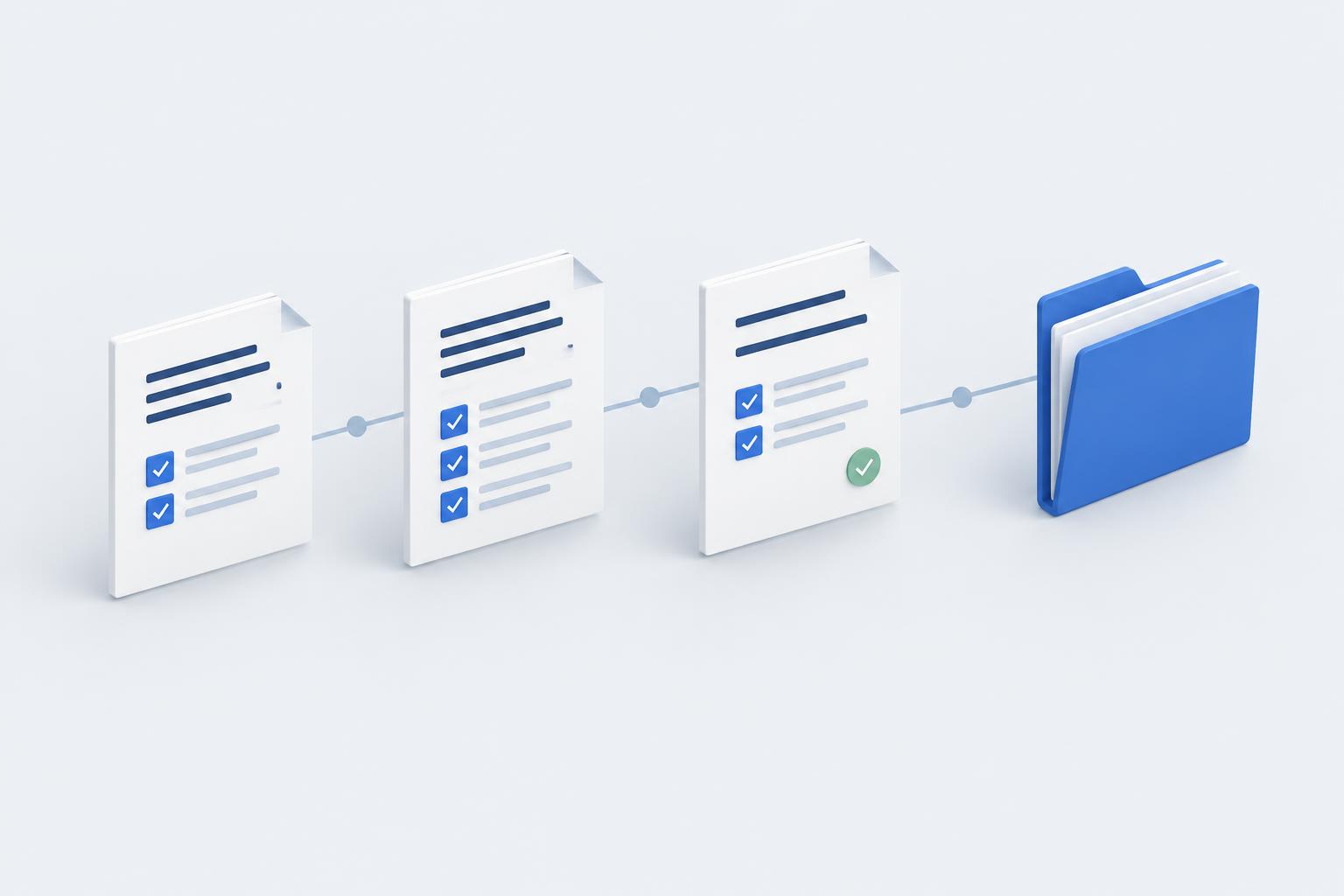
Focus on the delays your team can influence
Not every delay in a finance application sits within the dealership’s control. Lender review, customer circumstances and unresolved evidence can all affect timing. A practical improvement programme starts with avoidable handoffs, repeated requests and unclear ownership.
The following five approaches are workflow suggestions, not a promise of approval or a fixed turnaround time. Keep the quality of the application and the customer’s understanding ahead of speed.
1. Set clear document requirements
Give the customer a tailored checklist at the start. Explain each requested item in plain language, including any confirmed date range, completeness requirement and approved upload method. Flag anything still dependent on lender confirmation.
Use a short internal review checklist as well. A received file may still be unreadable, incomplete or inconsistent with the application. Catching that early is more useful than discovering it after submission.
2. Collect information early
Identify the information needed to prepare the application before the final handover wherever practical. Ask about relevant employment changes, current commitments or unavailable documents while there is still time to clarify them.
Avoid collecting information simply because it might be useful later. Follow your organisation’s approved process and keep requests relevant to the application. A broad request for everything can confuse the customer and create more review work.
3. Make follow-up consistent
Use reminders to bring attention to specific outstanding items, not to repeat the entire request. Agree who owns follow-up and when a phone call is more appropriate than another message.
If reminders are automated, confirm that completed, paused or withdrawn applications stop receiving them. Provide a way for the customer to explain a problem so the team can resolve it rather than repeatedly sending the same request.
4. Track the next action, not just the status
A status such as ‘in progress’ says little about what needs to happen. Record the owner, outstanding issue and next action so another team member can pick up the application without reconstructing it from emails.
Keep ‘awaiting customer’, ‘ready for review’ and ‘submitted to lender’ distinct. A shared progress view helps the team direct attention to the applications that need action instead of opening every file repeatedly.
Sentriq provides a centralised workspace where finance teams can monitor application progress, track outstanding documents and identify applications requiring attention. This improves visibility across the workflow without changing how each lender assesses the application. Request a demo of application tracking.
5. Reduce repeated manual administration
Look for places where staff repeatedly copy the same details or reconcile information across several lists. Reusable request templates, consistent naming and a central application record can help, provided the team checks details rather than assuming a template is correct.
Measure the process using your own records. Separate time awaiting the customer, internal review time and lender response time. This makes it easier to identify an actual bottleneck without blaming the wrong part of the workflow.
- Review repeated document requests and why they occurred.
- Track applications handed over without a clear next action.
- Check whether missing information was identified before submission.
- Compare process changes using consistent definitions, not anecdotal impressions.
A better handover is a useful outcome
An application that is complete, clearly explained and easy to review can reduce avoidable queries even when the lender’s decision takes time. The aim is a dependable process for customers and staff, not simply a busier reminder system.
General educational information, not financial or legal advice. Lender requirements and customer circumstances differ. Final assessment remains with the responsible finance professional or lender.
Back to Resource Centre